
Hormone Intelligence
The body’s internal language, translating your lifestyle into biological outcomes

For those new here, welcome!
Each week in The Informed, we explore health through body systems, connecting biology, behaviour, and everyday choices so you can better understand what your body is communicating, and how to respond to it with intention.
This week, we are talking about hormones. Over the past few years, hormone health has received more attention than ever before, for both women and men. Conversations around burnout, fertility, metabolic health, mood, libido, sleep, and performance have increasingly traced back to hormonal signalling. What was once framed as a “women’s issue” is now more accurately recognised as a whole-body, lifespan issue influenced by modern stressors, lifestyle patterns, and environmental load.
Health
The Interplay Between Sex Hormones, Thyroid Function, and Cortisol
Estrogen, progesterone, testosterone, thyroid hormones, and cortisol are part of a tightly regulated feedback system designed to prioritise survival, energy efficiency, and reproduction.
Cortisol, your primary stress hormone, plays a central role. In short-term stress, cortisol is adaptive and it mobilises glucose, sharpens focus, and supports blood pressure. This is what fuels your fight or flight response when you face danger. However, when your body is constantly stressed and being exposed to constant ‘danger’, cortisol begins to dominate hormonal signalling. The body shifts resources away from reproduction and repair toward survival. This has downstream effects. You may notice persistent fatigue despite adequate sleep, difficulty losing weight, increased anxiety, disrupted menstrual cycles, low libido, or feeling “wired but tired.” Blood tests may return as “normal,” yet symptoms persist because the issue is not deficiency, it is prioritisation.
Elevated cortisol can suppress thyroid hormone conversion (T4 to the active T3), slowing metabolic rate, digestion, and cellular energy production. This can present as cold sensitivity, brain fog, constipation, and reduced exercise tolerance. At the same time, cortisol can blunt progesterone production, particularly in women, contributing to symptoms such as disrupted sleep, heavier or irregular cycles, anxiety, and poor stress tolerance.
Estrogen alters how thyroid hormones circulate in the bloodstream, while progesterone supports cellular sensitivity to thyroid signalling. This is why symptoms often cluster rather than appearing in isolation and why addressing one hormone without considering the others can feel ineffective.
If you are experiencing hormone-related symptoms, the first intervention is assessing stress load, recovery, and energy availability. Supporting hormone health often begins with stabilising sleep-wake timing (see last week’s issue), reducing extreme training or caloric restriction, and improving blood sugar stability, before pursuing supplements or further testing.
To better understand your hormones (beyond my few paragraphs above), see my favourite resources below:
· The Huberman Lab Podcast: Essentials: How to optimize your hormones for health and vitality [Podcast]
· The Female Body Bible By Dr Emma Ross, Baz Moffat And Dr Bella Smith [Book]
· The Peter Attia Drive: Women’s health and performance [Podcast]
Wellness
Cycle-Aware Living and Training
The menstrual cycle is not a liability to manage. In fact if you come to understand it, it offers insight into energy availability, recovery capacity, and stress tolerance. Rather than asking “Should I train today?”, cycle-aware living asks “What type of stress can my body best tolerate right now?”. Across the menstrual cycle, hormonal shifts change how the nervous system, muscles, and metabolism respond to load.
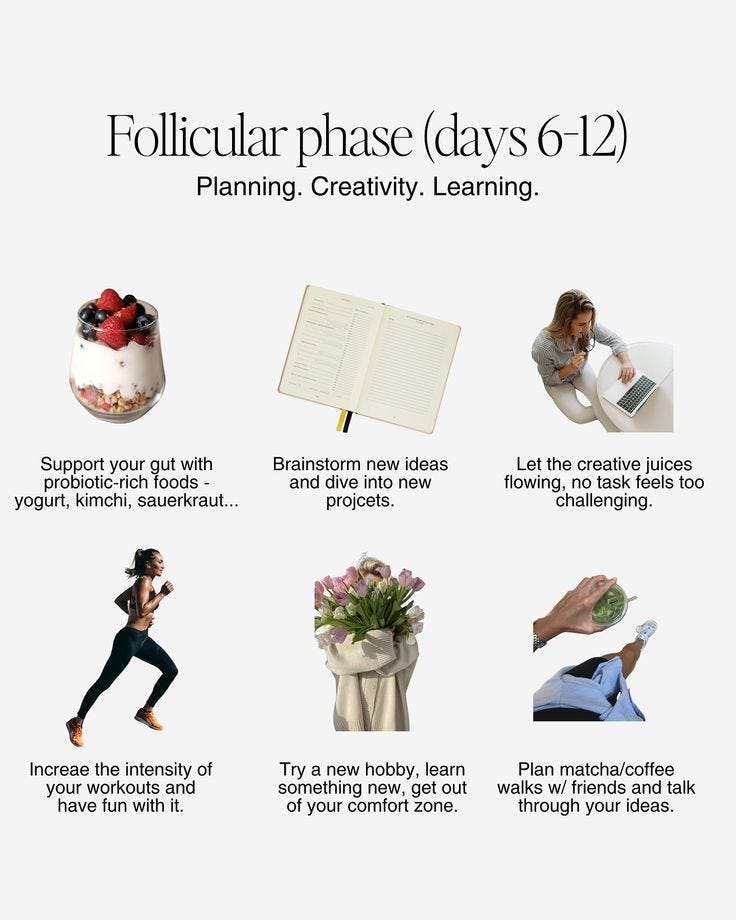
Follicular phase (period → ovulation)
Energy, motivation, and insulin sensitivity typically rise. This is an ideal window for learning new skills, higher-intensity training, initiating projects, and social engagement.
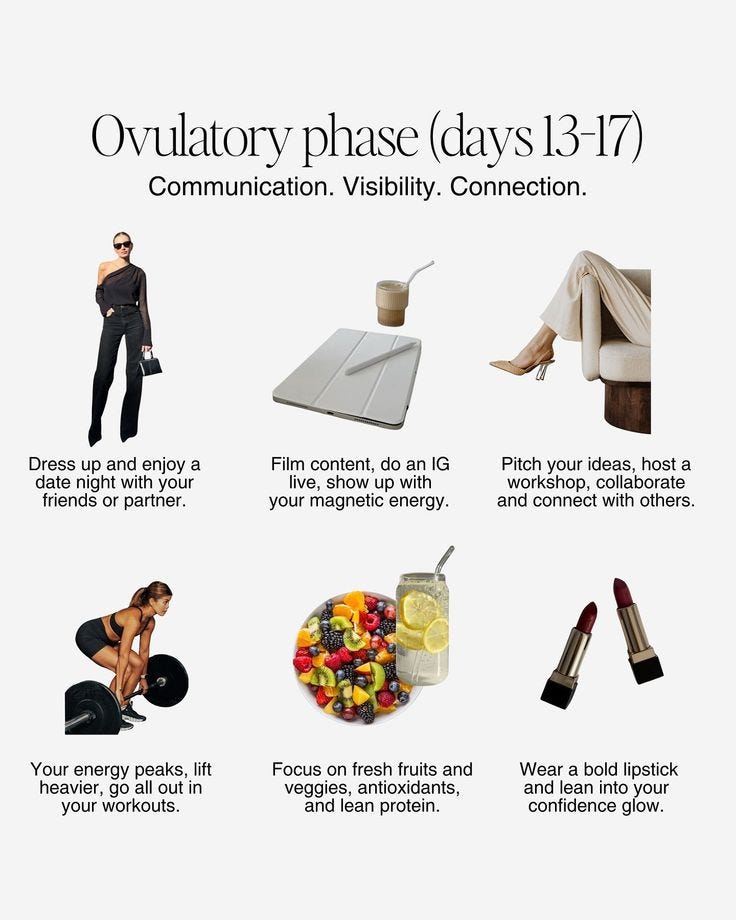
Ovulation
Strength and power peak, but connective tissue is more lax. This is a good time for performance, but not reckless volume. Prioritise warm-ups, recovery, and technique.
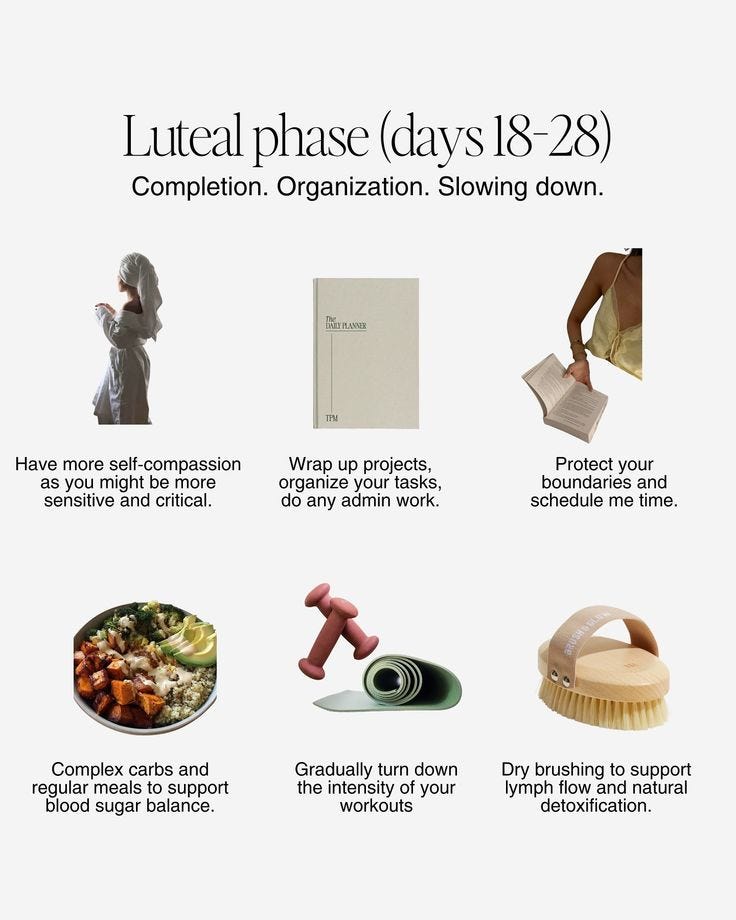
Luteal phase (post-ovulation → period)
Progesterone increases caloric needs and lowers stress tolerance. During this phase, many women benefit from reduced training volume, slower strength work, Pilates, walking, or mobility-based sessions. Cognitive load and emotional sensitivity may increase. Can’t recommend Pilates By Bryony enough for your 10-15 minute low-impact Pilates class when you can’t get into the studio. First 7 days for free!
Understanding these small things allows for strategic allocation of effort. When women consistently push high intensity through the luteal phase without adequate recovery, cortisol rises, progesterone falls, and symptoms such as PMS, sleep disruption, and burnout become more likely.
Helpful listening to build cycle literacy
· Fast Like A Girl By Dr Mindy Pelz
Beauty
Hormones as the Hidden Drivers of Skin, Pigmentation, Oil, and Hair
The skin and scalp are hormonally responsive tissues. Fluctuations in estrogen, progesterone, cortisol, thyroid hormones, and androgens directly influence pigmentation, sebum production, inflammation, and hair cycling.
Estrogen supports collagen synthesis, skin hydration, and barrier integrity. When estrogen declines or becomes dysregulated, the skin may appear duller, drier, or more reactive. Progesterone has a calming, anti-inflammatory effect; low levels are often associated with premenstrual breakouts and heightened skin sensitivity. Androgens stimulate sebaceous glands. In periods of stress, cortisol can increase androgen activity, contributing to excess oil production and hormonally driven acne, particularly along the jawline and chin.
How this shows up on the skin and little things you can do:
Breakouts clustering around the jawline or worsening just before your period comes often reflect progesterone drops and cortisol sensitivity: use salicylic acid or La Roche Posay Efaclar Duo to reduce breakouts
Increased oiliness during stress is frequently cortisol-driven, not a need for harsher skincare
Pigmentation changes (including melasma) are commonly hormonally mediated, particularly during pregnancy, contraceptive use, or endocrine disruption (this one is a harder to treat condition, and I would recommend a dermatologist early on)
Hair shedding often occurs months after stress, illness, or under-fuelling, not at the time of the trigger. Fun fact: it actually starts around 3 months after the stressful event! So, if your hair is falling out, ask yourself – what happened 3 months ago?
A hormone-informed approach to beauty looks beyond topical products. It considers sleep, blood sugar stability, stress load, cycle health, and nutrient sufficiency as foundational to skin and hair outcomes.