
System Regulation
Issue 12

This read is a little longer than usual, but with the new year approaching, it felt worth diving deeper.
We’ve officially entered New Year Resolution territory. And while the traditional goals; lose weight, exercise more and stress less, will inevitably resurface, this year I want us to approach them with better reasoning and a higher success rate. My hope is that, with the next few reads before the clock strikes midnight on the 31st, we can step into the new year together with a far clearer understanding of what we’re doing and why we’re doing it.
Over the past few weeks, we’ve zoomed in on the many signals our bodies send us, from our genetics, to our metrics, to the subtle shifts in energy and mood that quietly reveal how well (or how poorly) we’re coping with daily life. We’ve learned that optimisation doesn’t begin with doing more; it begins with listening. With paying attention to the data your body gives you every single day.
Now, we’re moving into a system we haven’t explored yet: the nervous system. The command centre that influences how we think, feel, heal, digest, sleep and even how we breathe. If your nervous system is stuck in survival mode (and I genuinely believe most of us are, without realising it), then nothing you layer on top, not the supplements, not the workouts, not the goals, will work the way you want them to.
This is the week we learn how to create internal safety, so the body can return to balance and finally respond the way it’s meant to.
Health
Nervous system regulation is a health essential, not a ‘nice to have’.
Think of your autonomic nervous system as a car with two gears:
Sympathetic Nervous System = Accelerator (fight-or-flight)
Parasympathetic Nervous System = Brake (rest-and-digest)
You’re meant to move between these gears depending on the road. But most of us drive with the accelerator pressed down all day, through red lights, traffic, school zones, without ever touching the brake. Eventually the engine overheats, the fuel burns fast, and the car stops responding.
In humans, this shows up as burnout, emotional fatigue, poor concentration, and that constant “running on fumes” feeling. A wise person told me: the strongest person in the room isn’t the one pushing hardest, it’s the one who knows when to tap the brake before the engine heats up.
Modern life doesn’t help: constant notifications, caffeine on an empty stomach, rushed mornings, irregular meals, and poor sleep keep many of us in a near-permanent sympathetic state. I’m always reminded of this when I go down the coast. it’s not that people are walking too slowly; it’s that I’m walking too fast!

And while the car becomes less responsive, the body begins compensating too:
Elevated heart rate —> feels like anxiety
Slowed digestion —> glucose spikes, weight changes
Hormonal shifts —> irregular cycles, fertility challenges
Rising inflammation —> higher chronic disease risk
If this sounds familiar, you’re likely the person who writes “stress less” on their resolutions list every year. But stress doesn’t reduce by wishing it away. It reduces through strategy. Try habit-stacking the following into your day:
Morning light exposure. Your stress response begins in the brain. Morning light anchors your circadian rhythm and strengthens cortisol’s natural rise–fall pattern. A healthy morning cortisol curve = lower stress all day. Tip: I wake up and immediately open the blinds or sleep with them half-open so light naturally fills the room
Slow breathing. A simple, powerful way to activate the parasympathetic nervous system. The next section on wellness will dive into this further
Diet for a calm gut–brain axis. Your gut communicates with your brain through the vagus nerve. A nourished, diverse microbiome supports clearer signalling and a calmer nervous system. Revisit Issue 8 for the full list of gut-loving foods
Gentle, nervous-system-safe movement. Walking, yoga, Pilates or whatever your body calls for. These forms of movement help clear excess adrenaline and cortisol without overstimulating the system. A HIIT class has its place, but when you’re already dysregulated, it can push you deeper into sympathetic overdrive.
Wellness
Breathwork: the smallest action with the biggest impact
Over the past 12 months, I’ve been attending breathwork classes, something I’ll admit I originally walked into with full scepticism. Was I really going to sit through a guided breathing class?
But I walked out of that very first session genuinely transformed. For the first time, I understood what it meant to tap into the smallest (yet most powerful) physiological lever we have: our breath. I felt my entire system shift. And the science backs this. Slow, controlled breathing directly influences the stress response: it activates the parasympathetic nervous system, steadies heart rate, lowers cortisol, and sends a clear “you’re safe” signal to the brain.
The physiological sigh: two quick inhales followed by a long exhale, has even been shown to rapidly reduce stress in real time. (Watch below if you want to try)
What you can do:
Just try it. There are countless guided tutorials online if you’re not ready for a class. Sessions can range from 5 to 60 minutes. My favourite library is through Pilates by Bryony. Bonus: you get a free trial as a new client! Double bonus: her pilates classes are OUT OF THIS WORLD!
Use the physiological sigh during moments of overwhelm. I’ve tried this at work, and while people have asked if I was hyperventilating, I actually felt more grounded, more in control, and far more regulated
Anchor your day with two minutes of slow nasal breathing to shift your system out of overdrive.
Breathwork is the simplest entry point into nervous system regulation, and the one we overlook the most.
Beauty
The Compromised Skin Barrier: Returning to ‘Normal’
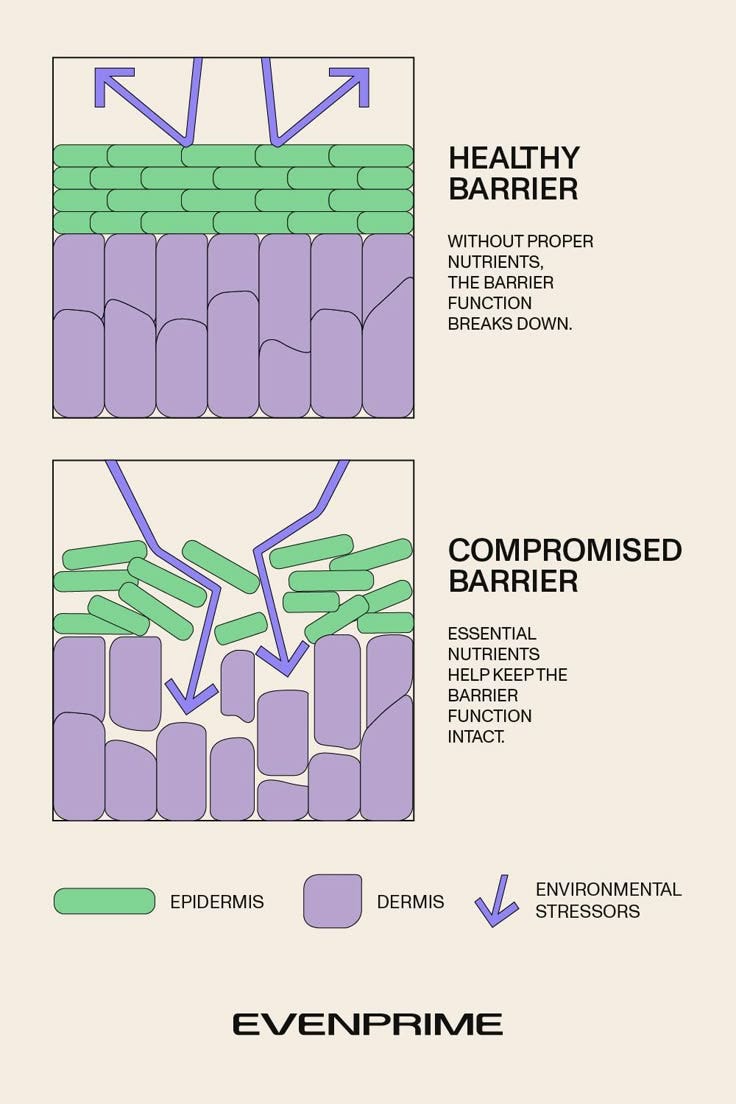
Your skin barrier is your built-in protection system: a structured layer of lipids, proteins, and microbiome organisms that keeps moisture in and pathogens out. When it’s damaged, the skin becomes vulnerable which shows up as redness, tightness, stinging, flakiness, breakouts, or a sudden sensitivity to products that never used to bother you. This is your skin’s fume engine screaming - STOP!
What compromises it?
Dermatologists point to a few major factors: over-exfoliating, mixing too many actives at once (retinoids, AHAs, BHAs, vitamin C), using harsh cleansers, hot showers, low humidity, and UV exposure. Stress, travel, and poor sleep increase transepidermal water loss, weakening the barrier further. The hidden culprit is “doing the most” with skincare, as it can strip away the very lipids your skin relies on to stay calm and functional.
How long does it take to heal?
With the right routine, you can see improvement in 2–4 weeks, but more severely compromised barriers may take 6–8 weeks to fully restore the skins balance and resilience.
How to repair it:
Strip back your routine: pause exfoliants, scrubs, and strong actives
Choose gentle, pH-balanced cleansers to avoid further lipid loss
Prioritise moisturisers rich in ceramides, and fatty acids: the exact components your barrier is made of
Consider texture changes: thicker creams at night help reduce water loss from the skin
Protect the microbiome with non-stripping, gentle formulas
Support recovery from within: hydration + adequate sleep = optimal overnight repair.